
Motherhood Lessons from a Sunday Morning Golf Practice in Koh Samui
Let’s take a little break from my recent dating reflections. Because this morning, my 7-year-old son Noah gave me a much more interesting life lesson. What was supposed to be a relaxed Sunday morning at the golf range in Koh Samui turned into a moment of frustration, emotions, and one of those unexpected parenting conversations about patience and learning new things. It reminded me how small moments in a child’s world can feel incredibly big, and how parenting often turns the most ordinary mornings into powerful life lessons.
4/5/20265 min read
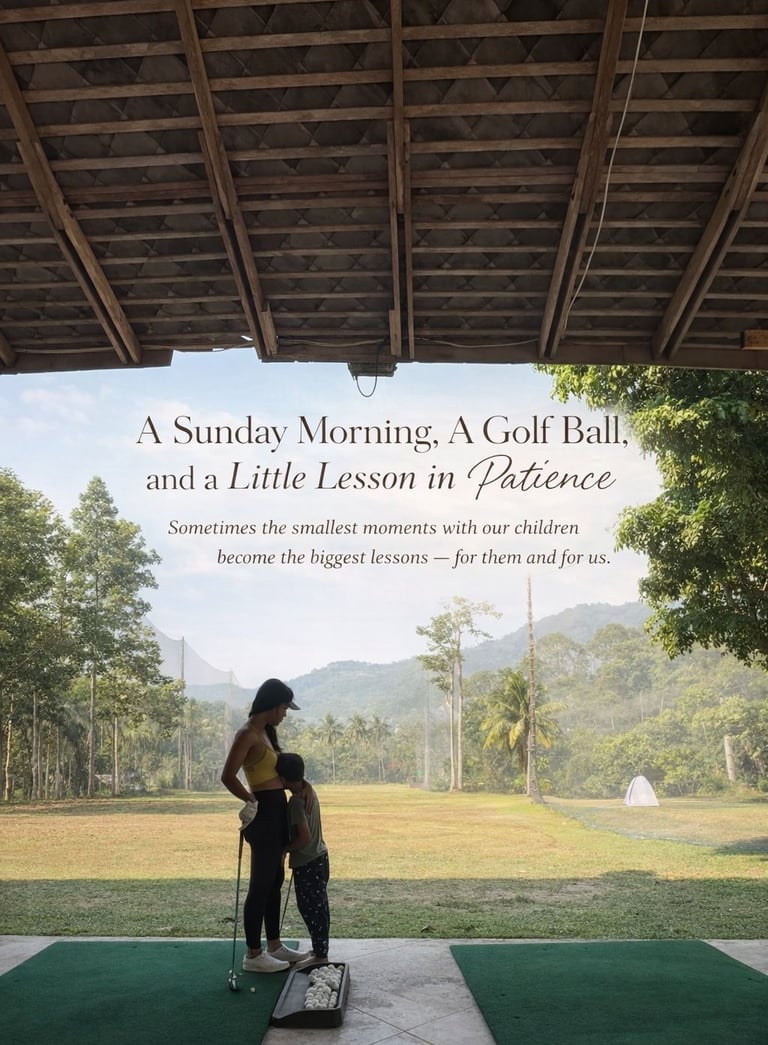
Sunday mornings on the island always feel a little slower.
The air somehow feels softer, the light gentler, and the world seems to give you permission to move at a different pace. It’s one of the small things I’ve come to love about living in Koh Samui — mornings here remind you that not everything in life needs to be rushed.
This morning, Noah and I decided to go to the golf range. The plan was simple. Just a bit of fun together. Nothing serious. Just a mother and her son hitting a few balls and enjoying a quiet start to the day.
Noah is seven now, and like many boys his age, he already has a strong competitive streak. Golf is still very new for him — he has only played once before — so this was really just his second time trying.
In my mind, it was just going to be a relaxed Sunday activity.
But as most parents know, things with children rarely go exactly the way we imagine.
At the beginning, Noah was excited. He held the golf club with that beautiful mix of curiosity and determination children naturally have when they try something new. He watched me carefully every time I swung, studying my stance and the way the ball lifted into the air.
Then it was his turn.
His first swing sent the ball rolling just a little forward.
He tried again.
Miss.
Another swing.
Miss again.
And within a few minutes, I could see the frustration slowly starting to build.
He wanted the ball to fly the way it did when I hit it. He wanted it to go straight and far. But his little hands were still learning how to control the club, how to balance his body, how to connect everything together.
Golf is not easy — even for adults. For a seven-year-old who has barely played before, it can feel almost impossible.
Soon I could see the change in his face. The excitement that was there at the beginning slowly disappeared and frustration took its place. His shoulders tightened. His swings became harder and faster.
“I can’t do it,” he said, clearly upset.
Suddenly the golf club seemed heavier in his hands, and every swing carried more emotion than the one before.
That was the moment I realized we were no longer just practicing golf.
We were dealing with feelings.
So I paused.
We stepped away from the mat and sat down for a moment. I could see the disappointment in his eyes. For him, this wasn’t just about hitting a golf ball anymore. In his little world, it had suddenly become something much bigger.
And that’s something I’m slowly learning as a parent.
What feels small to us can feel enormous to a child.
The funny thing is, just the day before Noah had played in a football tournament with his team. They finished third place. Throughout the games there were losses and mistakes, but he handled everything so gracefully.
I remember watching him that day and feeling quietly proud. He accepted the result calmly, laughed with his teammates, and celebrated their third place like it was still a victory.
So when I saw him so upset over a golf ball the very next morning, I couldn’t help but smile a little inside.
Yesterday he handled a football tournament like a little champion.
Today, a small white golf ball was creating a full emotional storm.
Children are fascinating like that.
Their emotional world doesn’t follow logic the way ours does. Sometimes big things don’t seem to bother them at all, and sometimes the smallest things suddenly feel enormous.
As we sat there, I told him something I often remind myself too.
“Do you know how many times mommy had to practice before I could hit the ball like that?”
He looked at me, still upset but listening.
I explained that learning something new takes time. Our bodies and our brains need practice before they understand how things work. And practice usually means making a lot of mistakes first.
But when you are seven years old, patience is not exactly your strongest skill.
To be honest, sometimes it isn’t ours either.
So I gently told him something simple.
He didn’t need to be perfect.
Not today. Not tomorrow.
The point of learning something new is not to be good immediately. The point is simply to try. To enjoy the process. To laugh at the bad shots. And then to swing again.
I could see his little mind slowly processing this.
Parenting often feels like this quiet responsibility that appears in the most unexpected moments. You think you’re just going out for a casual Sunday activity, and suddenly you’re helping a tiny human learn how to deal with frustration.
No pressure, right?
Sometimes I laugh about it.
You take your child to play golf for fun… and suddenly you’re giving life lessons at the driving range.
But that’s the thing about parenting.
Life never warns you when these moments are coming.
They just appear.
At the football field.
At the dinner table.
During bedtime stories.
Or on a quiet Sunday morning with a golf club in a seven-year-old’s hands.
What I’m learning more and more is that children don’t just need guidance when something goes wrong.
They need their feelings to be acknowledged first.
Before advice.
Before correction.
Before solutions.
They simply need to feel understood.
So I told Noah something very simple.
“It’s okay to feel upset.”
I think sometimes as adults we rush children past their emotions too quickly. We say things like “It’s not a big deal” or “Don’t cry.”
But in their world, it is a big deal.
Their emotional landscape is still new territory.
And honestly, even as adults we are still learning how to navigate our emotions.
After sitting quietly for a few minutes, Noah took a deep breath.
“Can I try again?” he asked.
Of course.
This time the swing wasn’t perfect.
But the ball moved forward.
And that was enough.
The rest of the morning slowly became lighter again. We laughed at the bad shots. We celebrated the good ones. And his frustration slowly melted back into curiosity.
Watching him reminded me of something simple but powerful.
Sports — and play in general — are rarely just about the activity itself.
They quietly become spaces where children build character. Where they learn patience. Where they discover resilience. And where they slowly understand that not being good at something yet doesn’t mean they never will be.
It simply means they are learning.
When we finally left the golf range that morning, Noah seemed happy again. The emotional storm had passed as quickly as it arrived.
Children are beautiful like that.
They feel deeply — but they also move forward quickly once they feel safe again.
On the walk home, I found myself reflecting...
Parenting has this funny way of turning simple moments into meaningful ones.
You think you are just sharing a quiet Sunday activity with your child. But hidden inside that moment are opportunities to shape how they see themselves, how they face challenges, and how they understand their own emotions.
And sometimes those lessons are not only for them.
They are for us too.
Watching Noah struggle reminded me of something I often forget in my own life.
We are all still learning.
We are all still swinging at our own version of the golf ball — sometimes missing, sometimes getting it right, and sometimes feeling frustrated along the way.
Maybe the real lesson this morning wasn’t just for Noah.
Maybe it was also a gentle reminder for me.
To slow down.
To be patient.
To allow mistakes.
To enjoy the process.
Because whether you are seven years old or almost forty, life is still a practice round.
And sometimes the most meaningful lessons appear in the most ordinary Sunday mornings.
From my heart to yours,
CM